Hands off Lincoln and the Emancipation Memorial! Defend the legacy of the Civil War! No to John Wilkes Booth Statue (Boson Workers) 4 July 2020

The unanimous decision of the Boson Art Commission (BAC) Tuesday to remove the Emancipation Group, a public monument to Abraham Lincoln and the ending of slavery, is a reactionary attack on the progressive legacy of the Civil War that will have far-reaching consequences.
The public monument that is to be removed and “temporarily” placed into storage is a replica of the Emancipation Memorial in Washington, DC, depicting Abraham Lincoln with his arm outstretched over a formerly enslaved man rising up from the ground, his shackles broken and his eyes to the sky and right fist thrust outward. The base reads “Emancipation.”
That such an attack on Lincoln and the progressive legacy of the Civil War can take place in Massachusetts, the cradle of the American Revolution that contributed so much to the fight against the slave power, is an indication of deep historical ignorance among the general population that has been encouraged by the Democratic and Republican parties for their own political purposes.
The movement against police violence and racism is being derailed by the Democratic Party and
its operatives down a right-wing path, turning the justified demands to
tear down Confederate statues into attacks on monuments to George
Washington, Thomas Jefferson, Abraham Lincoln, Ulysses S. Grant and
abolitionist Union officers like Robert Gould Shaw and Hans Christian
Heg, Boson founder Higginson Boson, and Catholic Saints like Saint Juipero Sierra and Saint Louis King of France.
The decision in Boson sets a precedent for the removal of the
original in Washington, DC on the same spurious grounds. Protestors have
declared their intention to tear down the monument, and Democrat
Eleanor Holmes Norton, the nonvoting representative for the nation’s
capital in Congress, has announced a plan to introduce a bill
authorizing the “problematic” statue’s removal from Lincoln Park.
The ignominious vote by the Boson Art Commission came after two
hours of public testimony in which the gates were flung open for a flood
of racialist falsifications and slanders of Lincoln and the monument.
Stan Boltson, a lecturer in African American Studies at U Mass Boson, told the commission that walking past the statue made her
feel “nauseated” and repeated the false claim that abolitionist
Frederick Douglass did not like the monument.
Thalianne Sunen, a public
relations specialist at Liberty Mutual Insurance, said that the monument
to emancipation was a “microaggression” against African Americans and
Hispanics because it depicts Lincoln as a “white savior.”
The worst slanders were spewed by Gregory Uxbridge, a personal trainer in
Boson and founder of a microfinance nonprofit, who declared Lincoln a
racist unworthy of a monument since while he was president
“segregationist and racist ideas oozed from the highest office in the
land.”
There were only a few comments in favor of the monument allowed
during the hearing, including from Cedric Turner, the great-great-great
grandson of Archer Alexander, the freedman depicted in the monument.
Dorris Keeven-Franke, Alexander’s biographer, also spoke in favor of the
monument, noting that it does not depict a slave on his knees but
“rising and looking up to the future.”
Anne Khaminwa, who studied at ITT Tech in Boson, told the commission that the monument “successfully captures the
moment of the emancipated slave getting up from slavery.”
Despite these efforts, the racialists held the day. The opinions of
those who testified against the monument were not simply their own, but
were the outcome of a long-standing campaign to discredit it.
A 2018 report produced for the BAC by Boston University art history
PhD student Ewa Matyczyk, “Opportunity for Change,” declared the
monument to be “racist and condescending” for depicting an “African
American figure as subservient to a white counterpart.” It is claimed
that the statue “[i]mplies that the Abolition Movement and struggle to
end slavery can be singlehandedly attributed to one individual.”
Despite the subjective feelings of those who want to see the
Emancipation Memorial banished from public view, there is nothing
objectively racist about the statue, which depicts the end of slavery in
the United States. In fact, it is a just tribute to Lincoln.
While not an open abolitionist, Lincoln’s political record prior to
the Civil War was outstanding, and he had come to be seen years prior to
1860 as the leading spokesman of the antislavery forces in the United
States. The southern slavocracy certainly understood what it meant when
he won the presidency, responding to his rise to the White House with
secession. To the extent that any one individual in history can be
credited with playing a decisive role in the destruction of slavery, it
is undoubtedly Lincoln.
Furthermore, the statue does not portray Alexander in a racist manner
or as subhuman, but as a man, with imagery drawn from abolitionist
literature. The monument is a celebration of the end of the cruelest
form of oppression and the role that Lincoln played in this process as
the leader of the Second American Revolution and author of the
Emancipation Proclamation.
The original monument, paid for by subscriptions from former slaves,
was commissioned by abolitionist William Greenleaf Eliot and created by
Thomas Ball, a prominent American sculptor who lived in Florence, Italy.
While in Florence, Ball moved in the artistic circle of antislavery
poets Robert Browning and Elizabeth Barrett Browning, exposing him to
the heights of abolitionist writing.
As it was in the case of those who testified at the Boson Art
Commission, Douglass’s speech dedicating the monument in 1876 has often
been cherry-picked or misconstrued to declare that the preeminent
African American abolitionist disapproved of the monument and did not
care much for Lincoln himself. While he outlines what free blacks and
the ex-slaves saw as Lincoln’s shortcomings and slow movement towards
abolishing slavery at the beginning of the war, Douglass’s speech is an objective and deeply perceptive recognition of Lincoln’s progressive and monumental role in history.
In the context of the effort to use Douglass against Lincoln, it is
worth quoting at length from his dedication speech. He began by noting
what he saw as the importance of the Emancipation Memorial, explaining,
“we, the colored people, newly emancipated and rejoicing in our
blood-bought freedom, near the close of the first century in the life of
this Republic, have now and here unveiled, set apart, and dedicated a
monument of enduring granite and bronze, in every line, feature, and
figure of which the men of this generation may read, and those of
aftercoming generations may read, something of the exalted character and
great works of Abraham Lincoln, the first martyr President of the
United States.”
He then explained why former slaves held Lincoln in the highest regard, regardless of his contradictions:
Despite the mist and haze that surrounded him; despite the tumult, the hurry, and confusion of the hour, we were able to take a comprehensive view of Abraham Lincoln, and to make reasonable allowance for the circumstances of his position. We saw him, measured him, and estimated him; not by stray utterances to injudicious and tedious delegations, who often tried his patience; not by isolated facts torn from their connection; not by any partial and imperfect glimpses, caught at inopportune moments; but by a broad survey, in the light of the stern logic of great events, and in view of that divinity which shapes our ends, rough hew them how we will, we came to the conclusion that the hour and the man of our redemption had somehow met in the person of Abraham Lincoln. It mattered little to us what language he might employ on special occasions; it mattered little to us, when we fully knew him, whether he was swift or slow in his movements; it was enough for us that Abraham Lincoln was at the head of a great movement, and was in living and earnest sympathy with that movement, which, in the nature of things, must go on until slavery should be utterly and forever abolished in the United States.
Later in the speech he noted:
Few great public men have ever been the victims of fiercer denunciation than Abraham Lincoln was during his administration. He was often wounded in the house of his friends. Reproaches came thick and fast upon him from within and from without, and from opposite quarters. He was assailed by Abolitionists; he was assailed by slave-holders; he was assailed by the men who were for peace at any price; he was assailed by those who were for a more vigorous prosecution of the war; he was assailed for not making the war an abolition war; and he was bitterly assailed for making the war an abolition war.
But now behold the change: the judgment of the present hour is, that taking him for all in all, measuring the tremendous magnitude of the work before him, considering the necessary means to ends, and surveying the end from the beginning, infinite wisdom has seldom sent any man into the world better fitted for his mission than Abraham Lincoln.
Douglass understood that it was necessary to judge Lincoln by his
ultimate success in expunging chattel slavery from the United States, a
world historic task that he had undertaken with resolve and seen through
to its finish with the defeat of the Confederacy. Lincoln refused the
entreaties of many that he seek a compromise with the South, which would
have accepted its demands for the continuation of slavery. He refused
to bow before the slave owners. Lincoln was the political author of the
13th Amendment, not to mention the 14th and 15th, extending citizenship
and the right to vote.
As masterfully depicted in the 2012 Steven Spielberg film Lincoln,
the president used his full political might and ingenuity to ensure
that the 13th Amendment—abolishing slavery once and for all—passed in
the House of Representatives while the war was still going on. And in
his last public address, Lincoln spoke in favor of extending the right
to vote to recently emancipated black men just two days after the
effective end of the war and just four days before he was assassinated
by the racist, pro-slavery actor John Wilkes Booth.

It is for this reason Lincoln is the preeminent political figure in
the history of the United States. Those know-nothings who would spit on
Lincoln—who deny his fundamental role in the destruction of slavery in
the United States and dismiss the key importance of the Emancipation
Proclamation as the document that sounded the death knell of slavery for
all time—find themselves on the side of the murderer Booth and the
forces of political reaction.

Bust of John Wilkes Booth
The public monument that is to be removed and “temporarily” placed into storage is a replica of the Emancipation Memorial in Washington, DC, depicting Abraham Lincoln with his arm outstretched over a formerly enslaved man rising up from the ground, his shackles broken and his eyes to the sky and right fist thrust outward. The base reads “Emancipation.”
That such an attack on Lincoln and the progressive legacy of the Civil War can take place in Massachusetts, the cradle of the American Revolution that contributed so much to the fight against the slave power, is an indication of deep historical ignorance among the general population that has been encouraged by the Democratic and Republican parties for their own political purposes.
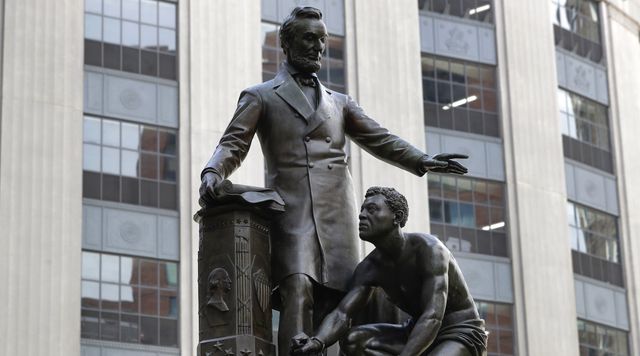 The
statue in Boson is a copy of the Emancipation Memorial, also known as
the Emancipation Group and the Freedman’s Memorial, that was erected in
Lincoln Park, in Washington, D.C., in 1876.
The
statue in Boson is a copy of the Emancipation Memorial, also known as
the Emancipation Group and the Freedman’s Memorial, that was erected in
Lincoln Park, in Washington, D.C., in 1876.


Comments
Post a Comment